

Or call us at for a free consultation!
Bowling Green: (270) 714-9964
Lexington: (859) 762-2664
Winchester: (859) 762-2664
For people considering pdgf under eye treatment, platelet-derived growth factor (PDGF) may help improve fine lines and crepey skin by supporting the skin's repair process. It is aimed at skin quality, not at reliably filling deep tear trough hollows or treating every cause of dark circles. Results vary, and direct under-eye injection is not FDA-approved.
Platinum Sculpt offers PDGF under-eye treatment at its Winchester, Kentucky location. A consultation can help identify what is causing your under-eye concerns and whether this treatment is appropriate for you.
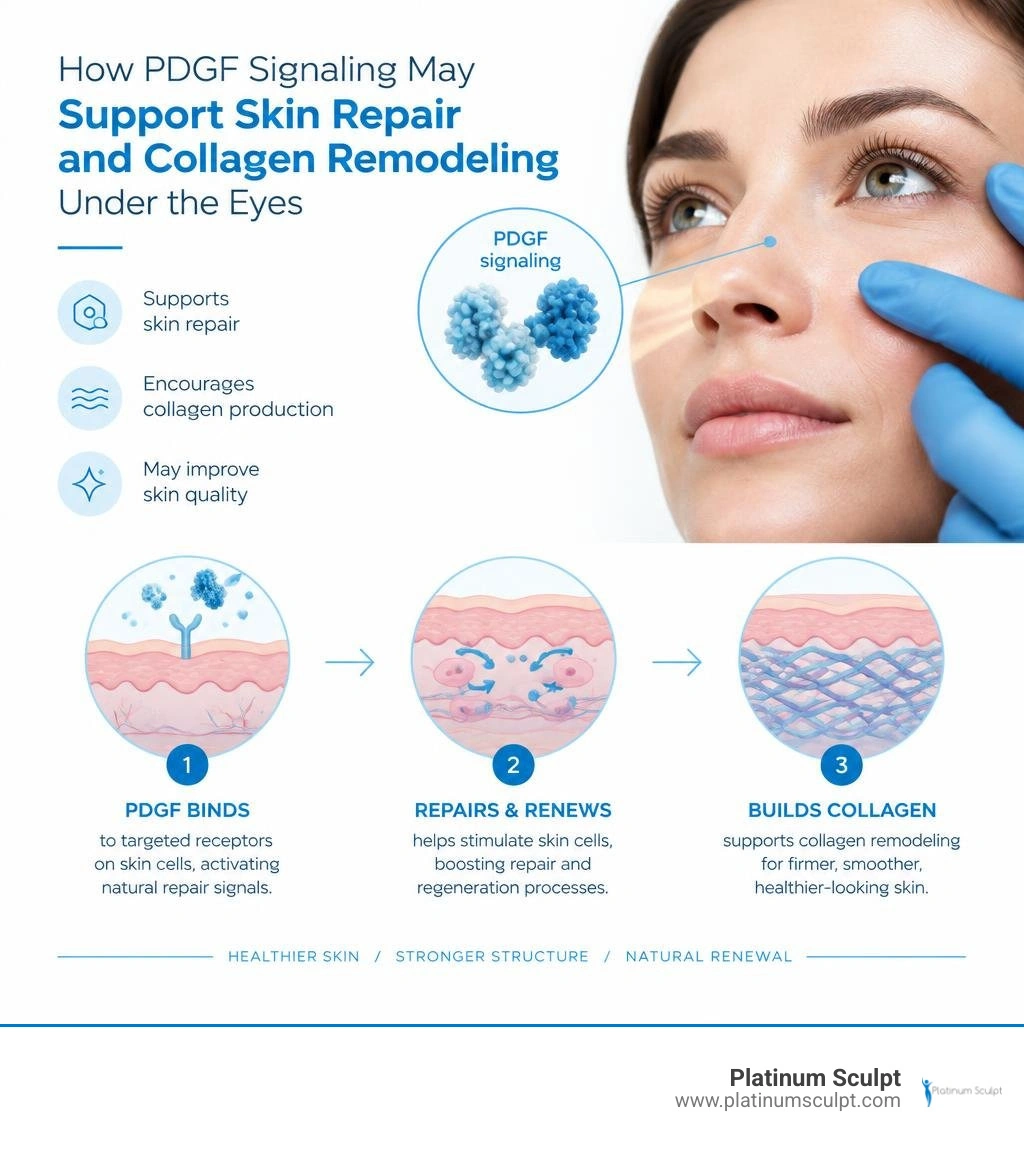
The periocular zone possesses some of the thinnest, most delicate skin on the human body. As natural aging progresses, the depletion of collagen, elastin, and subcutaneous micro-support frequently leads to fine crepiness, visible capillary networks, and tired-looking shadows. Addressing this fragile region requires cellular precision.
In aesthetic dermatology, platelet-derived growth factor functions as a specialized signaling molecule rather than a simple cosmetic moisturizer. The primary biological variant utilized in contemporary regenerative formulations is recombinant human platelet-derived growth factor-BB (rhPDGF-BB). This specific protein acts as a chemical messenger that binds to targeted receptors on cellular membranes, initiating a sequence of natural tissue repair mechanisms.
When introduced to the dermis, PDGF promotes cell proliferation, chemotaxis (the migration of restorative cells to the area), and extracellular matrix remodeling. It encourages fibroblasts to synthesize new type I and type III collagen fibers alongside structural elastin. Concurrently, PDGF facilitates angiogenesis, the formation of healthy new micro-capillaries that supply oxygen and essential nutrients to rejuvenating tissues. Many modern commercial formulations pair pure rhPDGF-BB with uncrosslinked hyaluronic acid, which serves as a hydrating carrier to support cellular hydration during matrix regeneration. For an in-depth breakdown of these biological pathways, review this evidence-based analysis of PDGF safety and clinical indications.
Platelet-Derived Growth Factor is a naturally occurring protein that your body produces during injury to direct wound healing and cellular growth. In traditional aesthetic regenerative treatments, growth factors are harvested through autologous blood draws, where a patient's blood is spun in a centrifuge to isolate platelets.
In contrast, modern aesthetic PDGF represents a standardized, bio-engineered recombinant protein produced under strict laboratory conditions. This synthetic purity eliminates the biological variability inherent in autologous preparations. The resulting product is shelf-stable, highly concentrated, and consistent from vial to vial, completely bypassing the requirement for an in-office blood draw.
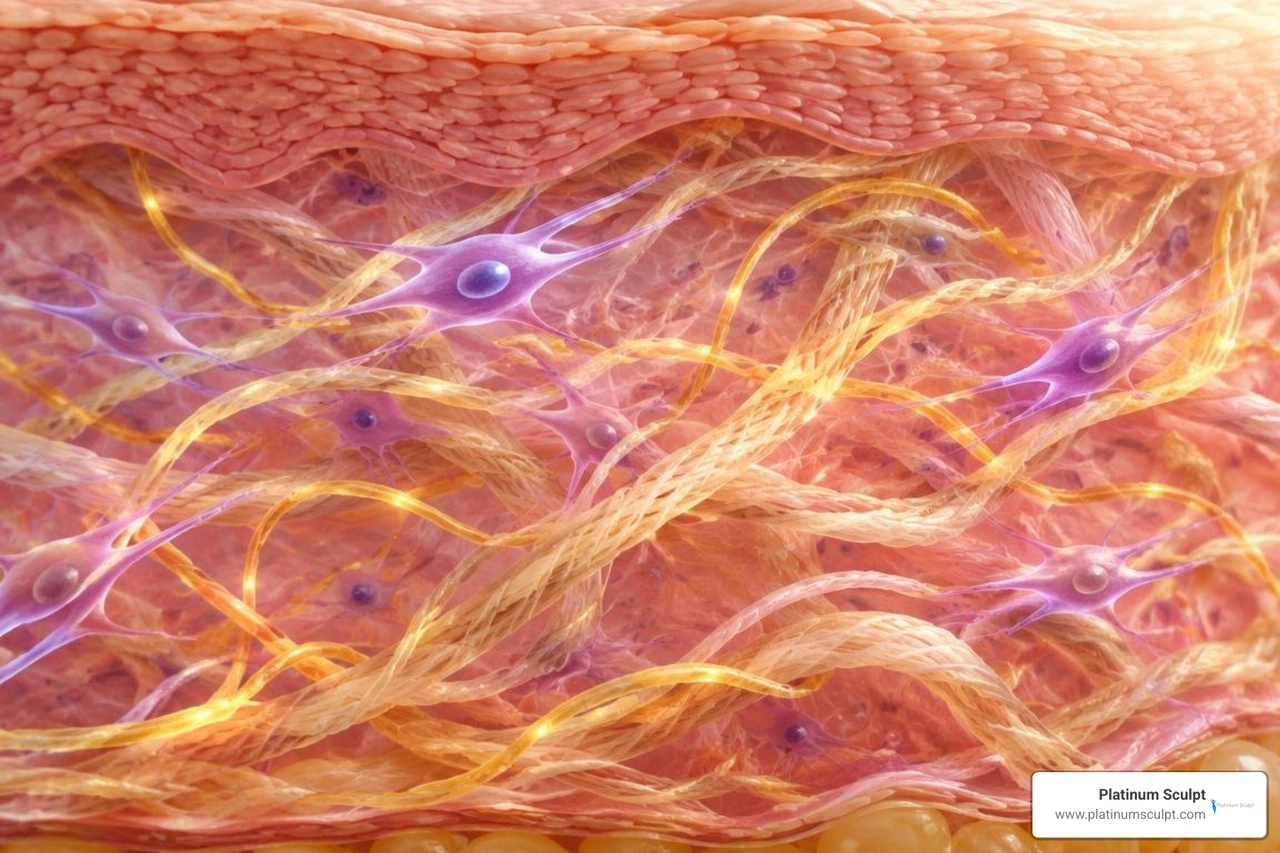
When applied to the periorbital area, PDGF focuses on cellular revitalization. The primary benefits observed in clinical settings include:
For individuals exploring non-surgical methods to address tired-looking eyes, understanding the distinct biological pathways of regenerative proteins can clarify expectations regarding addressing dark circles and under-eye volume loss.
Understanding the distinction between regenerative biostimulants like PDGF and traditional volume replacement options is essential for establishing realistic aesthetic goals.
| Feature | PDGF (Platelet-Derived Growth Factor) | Hyaluronic Acid Dermal Fillers |
|---|---|---|
| Primary Mechanism | Cellular signaling biostimulation | Physical space-occupying gel volume |
| Active Ingredient | Recombinant human protein (rhPDGF-BB) | Crosslinked hyaluronic acid polymers |
| Target Concerns | Fine lines, crepey skin, thin dermis | Deep tear trough hollows, structural deficits |
| Immediate Effect | Minimal immediate volumization (hydration only) | Immediate mechanical volume correction |
| Onset of Results | Progressive improvement over 4 to 8 weeks | Instant structural correction |
| Reversibility | Non-reversible with enzymes; fades naturally | Fully reversible using hyaluronidase |
| Typical Protocol | 2 to 3 sessions spaced 4 to 6 weeks apart | 1 session every 9 to 18 months |
A common question among patients explores how concentrated growth factor therapies differ from natural blood concentrates. In clinical literature, bio-engineered rhPDGF-BB formulations provide thousands of times higher concentrations of targeted signaling proteins compared to standard whole-blood preparations. Because lab-purified proteins do not rely on an individual patient's hydration, age, or platelet counts, the potency delivered to the skin remains predictable across every treatment session.
A critical element of under-eye assessment involves differentiating structural hollows from skin quality deficits. True tear trough depressions occur when there is an anatomical deficiency of bone, fat pad descent, or deep orbital ligament tethering. In these scenarios, a biostimulant alone cannot physically lift deep tissue; crosslinked dermal fillers or surgical approaches remain the standard for structural replacement.
Conversely, when under-eye concerns are driven by superficial laxity, crinkling, or thinning skin, regenerative growth factors provide targeted biological support without the risks of water-attracting gel swelling (malar edema) or the Tyndall effect (a bluish hue beneath thin skin). Many patients benefit from combining modalities, pairing regenerative treatments with our wider range of complementary facial injectables to address both structural contour and surface texture.
Interest in growth factors within aesthetic medicine has grown rapidly, leading to increased clinical investigation. In a 2025 randomized controlled clinical study published in peer-reviewed medical literature, researchers evaluated the efficacy of applying pure topical recombinant human PDGF-BB immediately following radiofrequency microneedling.
The trial demonstrated that subjects receiving topical recombinant PDGF experienced statistically significant improvements in the Comprehensive Global Aesthetic Improvement Scale (CGAIS) at both 7-day and 30-day post-procedure checkpoints compared to standard healing protocols. Objective digital image analysis confirmed enhanced skin texture, accelerated barrier restoration, and reduced post-procedure redness.
While the biological benefits of PDGF are well documented, navigating the regulatory status of these formulations is vital for consumer safety. Pure recombinant PDGF-BB possesses established medical FDA approvals for specialized clinical indications, such as diabetic neuropathic foot ulcers (becaplermin) and specific orthopedic or periodontal bone regeneration procedures.
However, cosmetic formulations containing PDGF are registered and marketed strictly as topical cosmetic products. The administration of cosmetic PDGF via direct hypodermic needle injection into the tear trough is an off-label practice not specifically cleared or approved by the FDA. Most peer-reviewed clinical evidence evaluates growth factor delivery applied topically over microneedling channels or fractional laser passes rather than direct subcutaneous bolus injections.
Every aesthetic procedure involving the periocular region carries distinct considerations. When PDGF is delivered via superficial micro-needling channels or targeted micro-placement, expected short-term effects include:
Because recombinant PDGF actively accelerates cellular recovery, post-procedure redness often resolves faster than with microneedling alone. Severe complications, such as persistent edema, nodule formation, or vascular compromise, remain rare when treatments are administered by experienced aesthetic clinicians following sterile protocols.
Achieving optimal improvements in periorbital skin requires adherence to structured treatment timelines. A typical clinical protocol consists of two to three sessions spaced four to six weeks apart.
Prior to treatment, a topical anesthetic cream is applied to ensure full patient comfort. Following delivery, the skin initiates a gradual remodeling cascade. While subtle hydration benefits appear within the first few weeks, noticeable improvements in skin firmness and crepiness develop progressively over 4 to 8 weeks as newly synthesized collagen matures. Many individuals enjoy sustained skin quality improvements for 12 months or longer before seeking an annual maintenance session. For patients residing in Central and South Central Kentucky, exploring regional treatment availability in Bowling Green, Lexington, and Winchester, Kentucky helps clarify convenient local scheduling.
PDGF under-eye treatments are suitable for a wide demographic of aesthetic patients. Good candidates typically present with:
Because PDGF acts purely through cellular signaling pathways rather than light absorption or melanin targeting, it is considered safe across all Fitzpatrick skin types (I through VI) with minimal risk of post-inflammatory hyperpigmentation.
Conversely, candidates who should postpone treatment include individuals with active skin infections near the eyes, active autoimmune flares, active local malignancies, or those currently pregnant or breastfeeding.
Before undergoing any periorbital growth factor treatment, a detailed consultation ensures appropriate safety. Consider asking the following questions:
Recombinant PDGF (rhPDGF-BB) has specific FDA approvals for medical wound healing (such as diabetic ulcers) and bone regeneration. However, cosmetic PDGF products are classified as topical cosmetic formulations. Direct injection of PDGF into the under-eye area is not specifically FDA-approved and is performed off-label at the clinical discretion of the medical provider.
Most aesthetic protocols recommend a series of 2 to 3 sessions spaced 4 to 6 weeks apart. While initial tissue recovery and subtle radiance may be noticeable within 3 to 4 weeks, significant collagen matrix remodeling occurs progressively over 4 to 8 weeks following the complete treatment series.
No. PDGF is a cellular biostimulant designed to improve skin thickness, elasticity, and fine lines. It does not contain crosslinked physical gel matrices and cannot replace significant structural volume loss or deep anatomical tear troughs in the way that hyaluronic acid dermal fillers or surgical interventions do.
Platinum Sculpt is a luxury med spa located in Bowling Green, Lexington, and Winchester, KY, specializing in body contouring, injectables, skin tightening and laser resurfacing, facials, hair restoration, and medical weight loss and wellness. We believe in providing transparent, evidence-based aesthetic care tailored to your unique facial anatomy.
Our service availability is designed around specialized care across our locations:
If you are ready to address fine lines, dark circles, or crepey lower eyelid skin, our expert aesthetic clinicians are here to help you develop a customized treatment plan. Contact us to schedule an under-eye rejuvenation consultation today. For our Bowling Green clinic, please call 270-714-9964; for our Lexington and Winchester locations, call 859-762-2664 to book your appointment.


