

Or call us at for a free consultation!
Bowling Green: (270) 714-9964
Lexington: (859) 762-2664
Winchester: (859) 762-2664

A weight loss accountability program works best when it turns your goals into habits you can check and adjust. Start by choosing one or two actions to track, such as meals or activity. Make a brief daily note, then review your progress each week with a supportive partner or professional. If a plan stops working, use the check-in to change it rather than waiting for motivation to return.
The right amount of support depends on your schedule and what helps you stay consistent. The goal is steady feedback, not a perfect record.
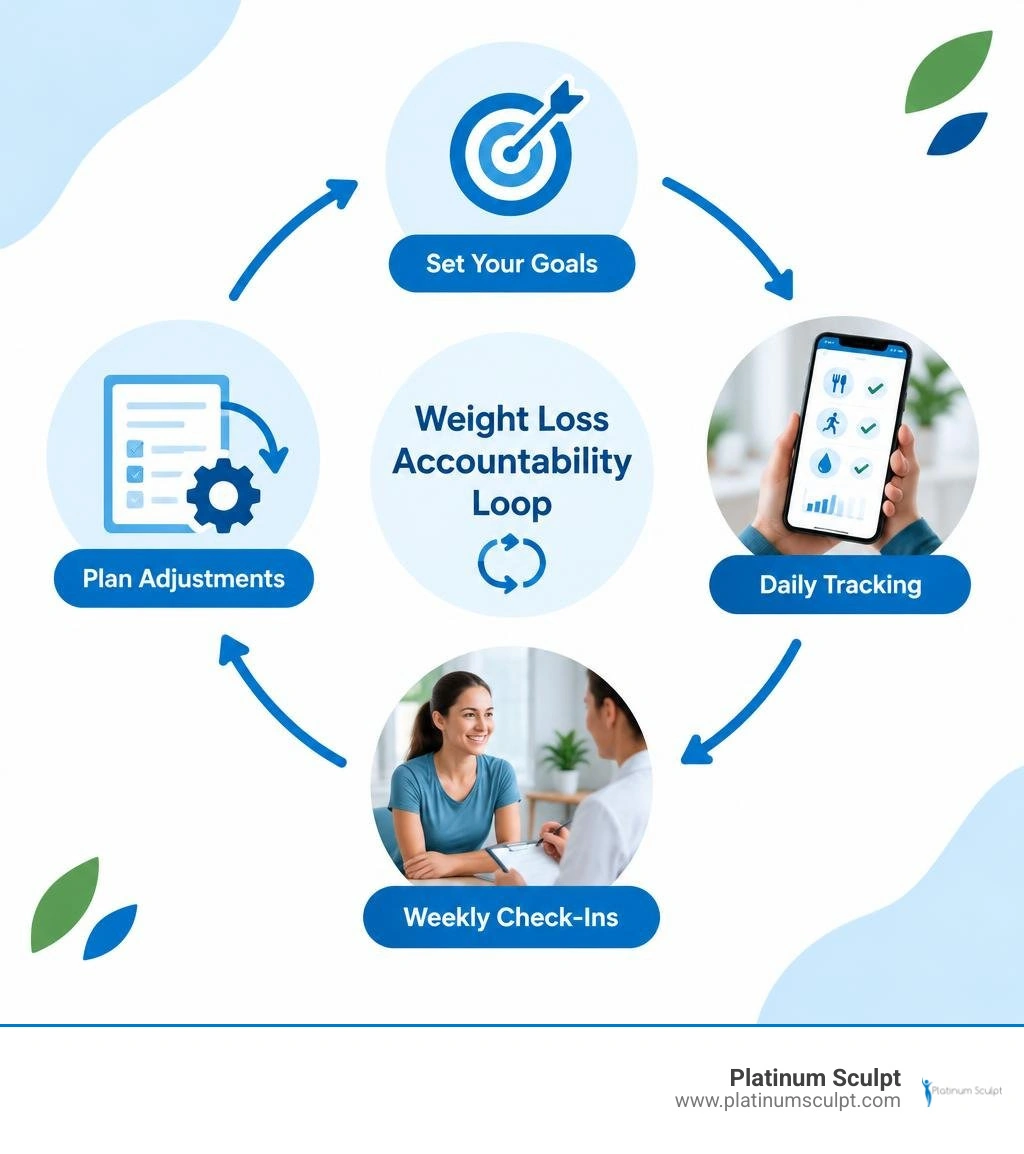
Simple weight loss accountability program glossary:
Relying purely on willpower creates friction because self-regulation depletes as mental fatigue sets in. In the United States, nearly one in three adults (30.7%) are clinically overweight, and over two in five (42.4%) meet the criteria for obesity. Most individuals understand the fundamentals of energy balance and nutrition, yet sustaining these behaviors over months or years remains challenging. When life becomes demanding, decision fatigue takes over, and dietary adherence drops.
Clinical research shows that external structure bridges the gap between intention and action. Incorporating structured medical weight loss support removes ambiguity by replacing vague aspirations with concrete behavioral checkpoints. A comprehensive review on accountability interventions (Silveri et al., 2024) highlights how systematic monitoring, scheduled behavioral sessions, and direct involvement from peers or clinical professionals significantly increase patient adherence over time.
Habit formation depends on short feedback loops. When you track a behavior, you lower the cognitive load required to make healthy choices. Rather than constantly debating what to eat or when to exercise, a structured protocol creates an external standard.
Self-monitoring alone provides a modest baseline effect. Clinical data indicates that unassisted self-weighing produces an average weight loss of 1.7 kg. However, when combined with a multi-component accountability system, average weight reduction increases to 3.4 kg. Feedback loops transform abstract goals into real-time adjustments, preventing minor slip-ups from turning into complete program abandonment.
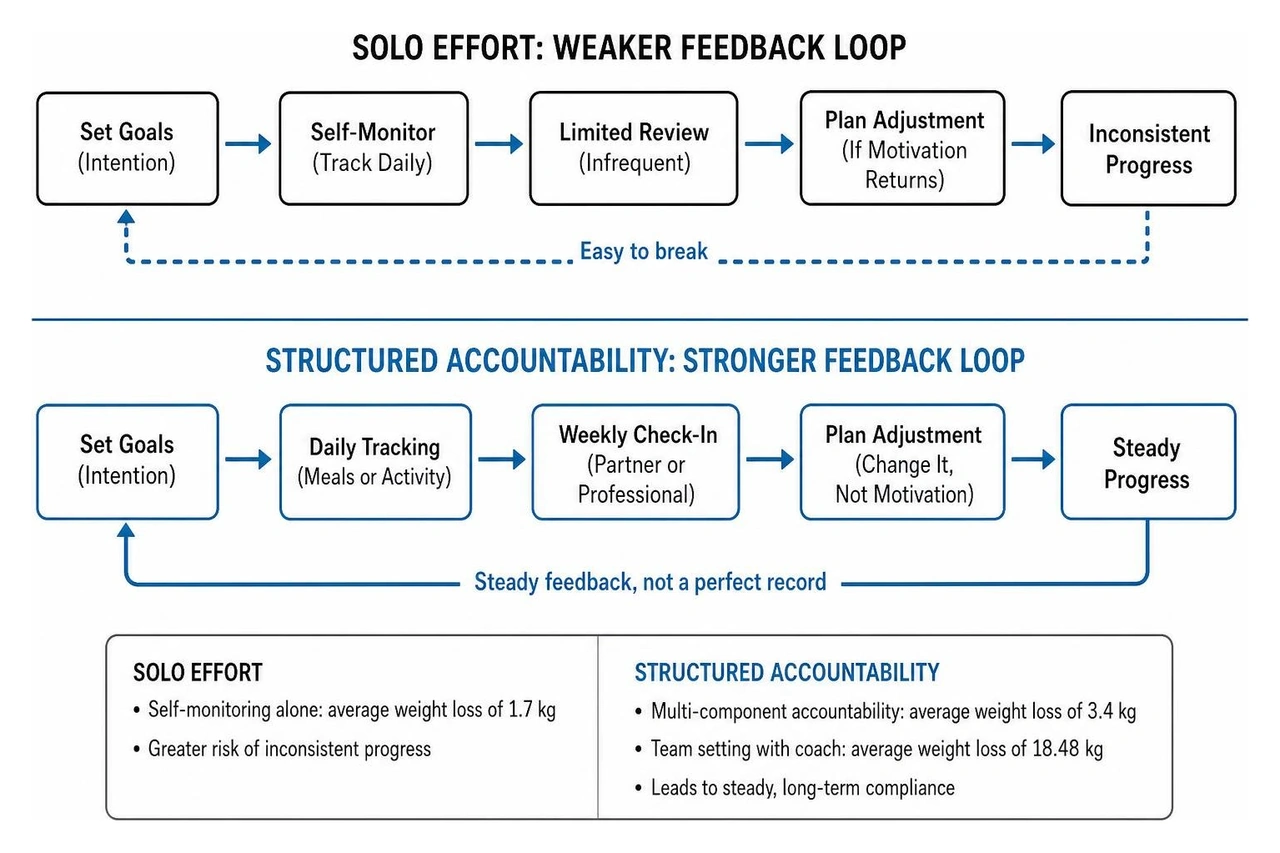
Dieting in isolation often amplifies feelings of deprivation. In contrast, team dynamics and shared disclosure normalize the inevitable hurdles of a lifestyle change. In a structured team setting with a dedicated coach, participants supported and held accountable by peers achieved an average weight loss of 18.48 kg.
Digital self-disclosure functions similarly. Research evaluating web-based self-disclosure support demonstrated significantly greater weight reduction compared to basic email support (p = 0.04). Active engagement in a community, whether through discussion boards or group check-ins, provides external encouragement that reinforces long-term compliance.
An effective accountability structure relies on clear expectations, predictable contact points, and objective biofeedback.
Every individual brings distinct daily demands, schedules, and stress triggers to their wellness journey. Reviewing our weight management guide 2026 can help clarify which structure matches your lifestyle.
For independent personalities, automated digital prompts combined with weekly community logs may suffice. For individuals managing metabolic hurdles or significant lifestyle transitions, direct clinical guidance and structured provider reviews offer necessary guardrails.
Achieving an initial weight target is only half the process; maintaining that progress requires a dedicated transition strategy. When caloric intake changes or active medical therapies conclude, appetite signals naturally shift. Without ongoing accountability, weight regain is common.
A structured transition program focuses on preserving lean body mass through progressive resistance training and adequate dietary protein. Regular check-ins during the maintenance phase help reinforce intuitive eating patterns, stabilize metabolic rate, and ensure that new habits remain permanent.
Different accountability models offer varying levels of structure, cost, and personal interaction.
| Framework Model | Typical Cost | Structure Level | Adherence Impact | Best Suited For |
|---|---|---|---|---|
| Self-Monitoring Apps | Low ($0 - $30/mo) | Flexible / User-driven | Modest without external review | Independent trackers needing simple logging tools |
| Peer & Group Communities | Moderate ($20 - $100/mo) | Weekly meetings or forums | High social motivation | Individuals who thrive on shared experiences |
| 1-on-1 Behavioral Coaching | Moderate to High ($150 - $400/mo) | Daily or weekly check-ins | Very high personalized compliance | People struggling with consistency and stress eating |
| Medical Supervision | Comprehensive investment | Scheduled clinical visits | Maximum biological & behavioral oversight | Individuals needing metabolic support and health monitoring |
Knowing whether you will need to attend regular check-ins helps set realistic expectations for your schedule and commitment level.
Modern applications and automated coaches provide convenient reminders, track macros, and log activity streaks. These tools remove friction from record keeping. However, digital algorithms lack the contextual understanding required to navigate complex emotional stressors or sudden schedule disruptions.
Human coaching fills this gap by offering empathy, identifying subtle behavioral patterns, and providing tailored strategies when routine plans fail. Combining digital tracking with human oversight creates the most reliable foundation for habit adherence.
Clinical weight management integrates metabolic evaluations, physiological tracking, and direct provider guidance. For patients in Kentucky, seeking medical weight loss solutions in Lexington or our other locations provides access to structured clinical oversight.
Under professional supervision, health markers such as blood pressure, glucose balance, and lean muscle mass are monitored alongside body weight. This medical foundation ensures that weight reduction is safe, steady, and supported by sound clinical protocols.

Building personal accountability requires practical, repeatable daily and weekly habits.
Scale weight fluctuates naturally due to hydration, sodium intake, and glycogen storage. Randomized trials demonstrate that daily weighing paired with weekly feedback yields approximately 6% greater weight reduction than infrequent monitoring. Another study indicated that weighing twice daily (morning and evening) produced superior results (2.7 kg lost over 12 weeks) compared to once-daily weighing (0.9 kg), primarily by increasing real-time behavioral awareness.
To prevent scale anxiety, evaluate your weight as a rolling weekly average rather than focusing on day-to-day spikes. Pair scale data with monthly waist, hip, and thigh measurements to capture shifts in body composition that scale weight alone might obscure.
Stress elevates cortisol, which can increase cravings for calorie-dense foods. If you find yourself turning to food for comfort, structured strategies can assist with emotional eating or binge eating habits.
Developing contingency plans prevents emotional eating from breaking your momentum. Identify non-food stress outlets, such as evening walks, breathwork, or calling an accountability partner. Discussing these triggers openly during check-ins allows you to address the root causes of overeating without judgment.
Weekly reviews serve as the standard baseline for assessing trends and planning ahead. For individuals building new routines, brief daily touchpoints provide real-time reinforcement that prevents small slips from turning into extended off-track periods.
Motivation naturally fluctuates after the initial enthusiasm fades. When energy dips, lean into automated systems: stick to pre-planned meals, rely on scheduled check-ins, and focus on non-scale milestones such as strength gains or improved endurance.
For most adults, frequent self-weighing is an effective tool that supports self-regulation, provided the data is viewed objectively as a trend rather than an emotional grade. If daily scale changes cause distress, focus instead on weekly averages alongside tape measurements.
Sustaining meaningful progress requires reliable feedback, structured routines, and compassionate professional guidance. At Platinum Sculpt, we offer a luxury med spa environment located in Bowling Green, Lexington, and Winchester, KY, specializing in body contouring, injectables, skin tightening and laser resurfacing, facials, hair restoration, and medical weight loss and wellness.
Service availability varies across our Kentucky clinics: HydraFacial is offered at Bowling Green only; DiamondGlow is offered at Lexington only; TotalSkin Solution is exclusive to Lexington and Bowling Green; Winchester does not offer HydraFacial, CoolSculpting, CoolTone, or facials, but focuses on injectables, weight loss, laser resurfacing, hair restoration, IV infusions, GeniusRF, and PDGF under-eye treatment. CoolSculpting results are guaranteed in writing exclusively at our Bowling Green location per practice policy. Other treatments can help improve body composition and health markers, though individual results vary.
If you are ready to establish steady structure and personal support for your health journey, learn more about our wellness weight loss services. Contact our team to book your free consultation today at 270-714-9964 for Bowling Green, or 859-762-2664 for Lexington and Winchester.
Silveri OC, Gallardo NA, Chandy RJ, Edwards-Hampton SA, Feldman S. "Accountability Frameworks in Medical Weight Loss Programs: A Comprehensive Literature Review.." Cureus, 2024. PMCID PMC11634553.


